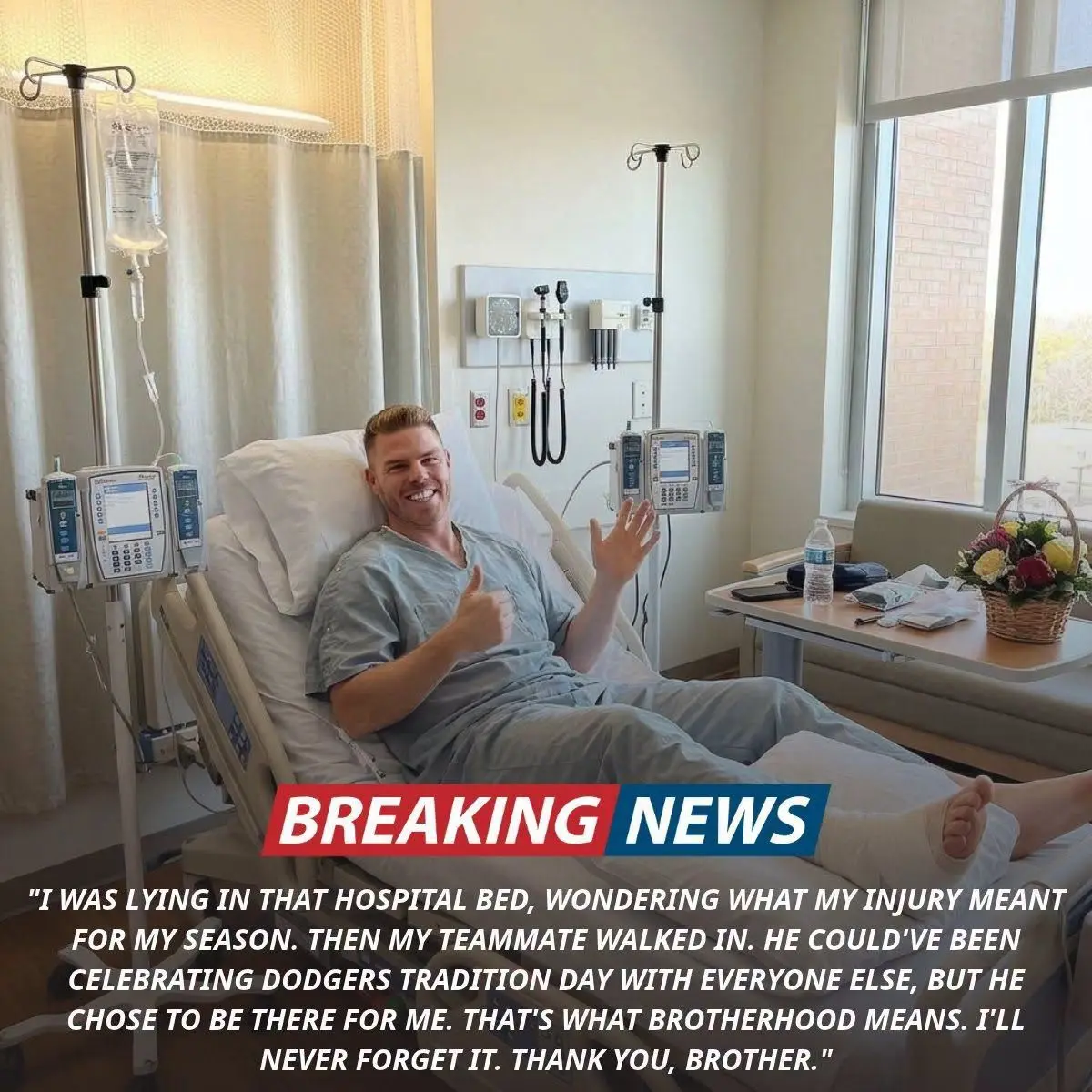
LOS ANGELES — For years, Freddie Freeman has been one of the most recognizable faces of the Los Angeles Dodgers. Known for his consistency, leadership, and extraordinary dedication to baseball, the veteran first baseman has built a reputation as someone who allows his performances to speak louder than his words.
But in an imagined emotional statement, Freeman finally addresses a question that has been weighing heavily on his mind: What does the future hold when a player begins to realize that the game he loves cannot last forever?
In this fictional story, a quiet conversation about his baseball journey develops into an unforgettable reflection on loyalty, family, sacrifice, and the meaning of wearing a Dodgers uniform.
And when Freeman finally reveals what he has been keeping to himself, the message is far more personal than anyone expected.
The Silence That Raised So Many Questions

The imagined scene begins at Dodger Stadium on a peaceful afternoon.
The stands are empty, the field is quiet, and the familiar sounds of thousands of cheering supporters have been replaced by an unusual stillness.
Freeman sits near the Dodgers dugout, looking toward first base.
For years, that position has represented countless hours of preparation, unforgettable victories, and the responsibility of helping his team compete at the highest level.
But in this fictional moment, his thoughts are somewhere else.
He remembers the excitement of joining Los Angeles, the pressure of enormous expectations, and the extraordinary experiences that followed.
He also remembers the sacrifices.
The demanding travel schedule.
The physical exhaustion.
The birthdays and ordinary family moments that professional athletes sometimes miss.
Eventually, he begins considering a question that every veteran player must confront.
How do you prepare for the next chapter when so much of your identity has been built around the game?
“I've Kept This to Myself for Far Too Long…”

In the imagined narrative, Freeman agrees to sit down for a private conversation about his career.
At first, he discusses familiar subjects: baseball, teammates, preparation, and the pride of representing Los Angeles.
But as the conversation continues, his expression becomes more serious.
He pauses, takes a breath, and looks toward the empty field.
Then he says:
“I've kept this to myself for far too long, because I didn't know how to explain what I've been feeling.”
The fictional statement changes the atmosphere.
For several moments, Freeman struggles to find the right words.
He explains that professional athletes often feel pressure to appear strong, confident, and completely focused on the next game.
But behind that determination, they experience the same uncertainty and emotional challenges as everyone else.
And sometimes, the most difficult conversations are the ones they must have with themselves.
The Emotional Truth Behind His Dodgers Journey
Throughout the imagined interview, Freeman reflects on what the Dodgers organization has meant to him.
He remembers arriving in Los Angeles with enormous expectations and a determination to contribute to a winning culture.
He thinks about the teammates who welcomed him, the coaches who supported him, and the fans who embraced him.
But one memory stands above the others.
The fictional Freeman recalls standing on the field after an unforgettable victory, surrounded by teammates who had spent months pursuing the same goal.
At that moment, he understood that baseball success was not simply about individual statistics.
It was about belonging to something larger than himself.
In the imagined conversation, he shares a deeply personal thought.
“When you put on this uniform, you carry more than your own dreams. You carry the hopes of your teammates, your family, and an entire city.”
The words capture the emotional significance of his Dodgers journey.
The Question About His Future
Eventually, the conversation turns toward the subject that supporters are most eager to understand.
His future.
Will he continue playing for years to come?
Does he imagine finishing his career in Los Angeles?
Or has he begun considering life beyond professional baseball?
In this fictional account, Freeman does not announce a retirement date, request a trade, or reveal a new contract.
Instead, he acknowledges that thinking about the future has become increasingly important.
He explains that the physical demands of baseball require discipline and resilience, especially as players grow older.
Recovery becomes more important.
Preparation requires greater attention.
And every season offers a reminder that time is moving forward.
But rather than expressing fear, Freeman begins speaking about gratitude.
“I don't know exactly how every chapter of my career will unfold. But I know I never want to take another day in this uniform for granted.”
The Family Sacrifices Nobody Sees
As the fictional interview continues, Freeman reflects on the people who have supported him throughout his career.
He thinks about his wife, Chelsea, and their children.
He remembers the countless occasions when family members adjusted their schedules, made sacrifices, and offered encouragement during difficult stretches.
For professional athletes, success is often measured through visible accomplishments.
Home runs.
Championships.
Individual awards.
But behind those achievements are families who experience the pressures of the season in their own ways.
In the imagined story, Freeman acknowledges that his career has been shaped not only by his dedication but also by the love and patience of those closest to him.
He explains that every decision about his future must consider more than baseball alone.
It must also consider the people who will remain beside him long after his playing days end.
An Unexpected Message to Dodgers Fans
The emotional turning point arrives when Freeman is asked what he would say directly to Dodgers supporters.
He looks toward the field again.
For a moment, he appears overwhelmed by memories.
Then he offers an imagined message filled with appreciation.
“You welcomed me, believed in me, and made me feel like I belonged here. No matter what happens in the future, that will always mean something to me.”
The fictional words reflect the connection between athletes and the communities they represent.
Freeman recognizes that fans invest enormous emotion in their teams.
They celebrate victories, endure disappointments, and create family traditions around the sport.
For many supporters, baseball becomes part of their personal history.
And in the imagined narrative, Freeman wants them to understand that their loyalty has never gone unnoticed.
The Final Revelation Leaves Everyone Emotional
As the fictional conversation approaches its conclusion, Freeman is asked one final question.
What is the one thing he has been afraid to admit?
He pauses.
Then he smiles.
“I've been afraid of how quickly time moves. Not because I'm ready to leave baseball, but because I love it so much that I wish moments like these could last forever.”
The answer reveals the emotional heart of the story.
Freeman is not announcing that he is walking away from the Dodgers.
He is acknowledging how deeply the game has shaped his life.
The fictional interview ends with him standing near the dugout, looking across the empty stadium.
He knows there will be more challenges, difficult games, and important decisions ahead.
But for now, he chooses to focus on the opportunity directly in front of him.
The most powerful revelation is not a shocking retirement announcement or a dramatic departure. It is Freddie Freeman's imagined realization that the greatest privilege of his baseball career is not knowing exactly how it will end, but appreciating every moment before that day arrives.
And as he walks toward the clubhouse, one final thought remains.
“When my playing days are over, I hope people remember more than the numbers. I hope they remember that I gave everything I had to this game and to the people who believed in me.”
For Dodgers supporters, the fictional message offers a reminder that even the greatest athletes are human.
Their careers are extraordinary, but their time on the field is finite.
And sometimes, the most meaningful promise a player can make is simply to give his best while he still has the opportunity.